
Four Common Injectable Fillers


Injectable fillers have become a mainstay in the nonsurgical treatment of facial deflation and regional augmentation. The most prevalent form of filler is hyaluronic acid (HA)-based, however, alternative, longer lasting fillers are also commercially available. HA is a ubiquitous member of the Glycosaminoglycan (GAG) group of Polysaccharides that is commonly found in most mammalian tissues.
In humans, the majority of HA is found in the skin, particularly the dermis. HA has many unique rheological, viscoelastic, and biological properties, which are primarily dependent on the size and preparation of the polymer. HA is negatively charged due to the repeating units of Glucuronic Acid, as a result, it is hydrophilic, which is a property that provides turgor, elasticity, moisture, and volume to the skin. HA fillers have been around since the 1980s and have evolved with every passing generation.
Four common injectable filler materials include the following:
HYALURONIC ACID (HA)
Hyaluronic acid fillers are typically soft and gel-like. The viscosity and structure of HA can be altered to provide a softer, more skin-like texture, or a more rigid formulation to create structure. The results typically last 6–12 months or longer, depending on the rate at which Hyaluronidase, a naturally occurring human enzyme, fragments the larger, high molecular weight HA into smaller fragments which are absorbed naturally.
CALCIUM HYDROXYLAPATITE (CaHA)
Calcium hydroxylapatite (CaHA) is a naturally occurring compound, most commonly found in human bone. The microscopic calcific particles take the body longer to degrade, therefore lasting for over 12 months. As the microscopic particles create more structure, the resultant product is more viscous than the equivalent HA filler, and appropriate gauged equipment needs to be considered. CaHA is FDA-approved (Radiesse) and was found to naturally stimulate collagen production and improve skin tone and quality
POLY-L-LACTIC ACID (PLLA)
Poly-L-lactic acid is a synthetic biodegradable and bio-stimulatory compound, most commonly found in dissolvable sutures. Similarly, to CaHA fillers, PLLA fillers (FDA-approved—Sculptra) stimulate collagen production and replace volume. As PLLA fillers primarily work on collagen synthesis, final results can take several months to appear; however, the results can last several years.
POLYMETHYLMETHACRYLATE (PMMA)
Polymethylmethacrylate (PMMA) is a biocompatible, synthetic filler. It is composed of microspheres suspended in bovine collagen as an injection medium. These synthetic microspheres are not absorbed by the body, therefore, PMMA fillers are commonly referred to as “permanent”. Similarly, to the above categories, PMMA (FDA approved—Bellafill) fillers have a thick consistency, therefore provide robust structure, while also being approved for more subcutaneous injections to stimulate collagen and provide continued results over time.
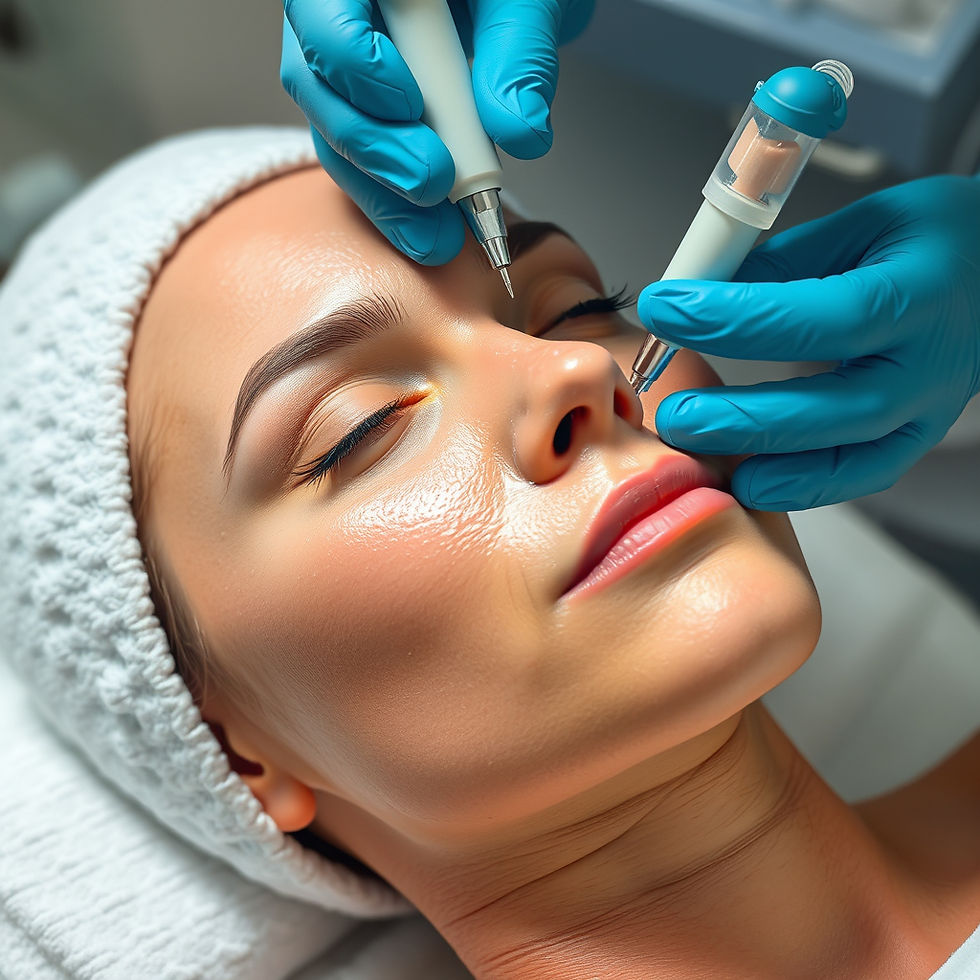
Injectable fillers require topical anesthetics for more sensitive areas and preference/comfort. The delivery of HA fillers can be with either an appropriate gauge needle to the viscosity of the product, or with a cannula for more superficial approaches and contouring. Deeper injections, with a higher viscosity, are recommended to be on periosteum and a needle would be the safest method of delivery. The use of ultrasonography, for direct visualisation and injection of fillers, particularly in higher risk areas (glabella, temporal, tear-trough, nose, and nasolabial) is becoming more common.
For all procedures, facial assessment and counseling need to be thoroughly addressed. Counseling regarding facial harmony and alternative treatments which may provide better results for current concerns need to be prioritized over financial gain. Injectable HA fillers are primarily created to address deflation and may not reliably provide a “lifting” effect to the areas of concern. Skin quality, facial laxity, and noticeable pre-procedural asymmetries (static and dynamic) need to be discussed prior to injection. Finally, consent and photographic records must be kept for all.
Complications to be discussed include erythema/bruising, infection, bleeding, hypersensitivity reactions, asymmetry, migration, nodules, Tyndall effect (bluish discoloration with superficial injections), and vascular occlusion. Injectors are to be aware of the signs of the above complications and be able to manage them appropriately. HA fillers can be reversed using Hyaluronidase and if necessary, the use of ultrasonography to help define the appropriate plane. Due to the biological composition of the alternatively mentioned fillers, they cannot be reversed using Hyaluronidase.
A novel method to remove a CaHA filler has been described by the senior author, Cohen et al In brief an 18G needle is used to puncture the skin, a “grater” type cannula is inserted to ream and aspirate the injected filler, with the objective of correcting contour deformities.
The overall assessment of facial harmony, laxity, and patient selection is critical. All HA fillers are temporary and primarily address volume loss. Selecting the appropriate filler at multiple levels of the face will ultimately lead to the most favourable results.
NOT MY OWN WORK. Taken from and for more information, see:
Al-Ghanim K, Richards R, Cohen S. A practical guide to selecting facial fillers. J Cosmet Dermatol. 2023; 22: 3232-3236. doi:10.1111/jocd.15867
Copyright © 2026 by the authors.
The above is taken from an open-access/ free-access article distributed under the terms of the Creative Commons Attribution License (CC BY). The use, distribution or reproduction in other forums is permitted, provided the original author(s) and the copyright owner(s) are credited and that the original publication is cited, in accordance with accepted academic practice. No use, distribution or reproduction is permitted which does not comply with these terms.


Comments